
Let’s be honest, most of us ignore our feet until something happens to them that causes pain or discomfort. We ask a lot of them and on average they have to carry us around 75,000 miles during our lifetime! Little wonder that many people suffer with their feet when they get older, though foot health problems are certainly not limited to the older generation. This page aims to examine the most common complaints and explain what I can do to treat them.
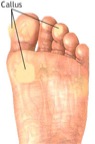
A callus is an extended area of thickened skin on the soles of the feet, and occurs on areas of pressure. It is the body's reaction to pressure or friction, and can appear anywhere the skin rubs against a bone, a shoe, or the ground.
Treatment: Removal of hard skin, relieving pain, and redistributing pressure with soft padding, strapping, or corrective appliances which fit easily into your shoes. The skin should then return to its normal state. The elderly can benefit from padding to the ball of the foot, to compensate for any loss of natural padding. Emollient creams delay callus building up, and help improve the skin's natural elasticity. I can advise you on the most appropriate skin preparations for your needs.

Treatment: There are many different types of corns. Treatment involves the excision of the hard skin (it’s called ‘enucleation’) using a scalpel. Sometimes a sterile antiseptic dressing is then applied depending on depth.
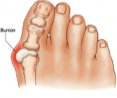
Treatment: Because they are bone deformities, bunions do not resolve by themselves and are usually are treated by surgery. The goal for bunion treatment by a foot health practitioner is to relieve the pressure and pain caused by irritations. Protective padding, often made from felt material, eliminates the friction against shoes and helps alleviate inflammation and skin problems. I can also recommend a night-time splint if necessary.
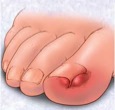
Treatment: Foot Health practitioners can diagnose this painful condition, and if in the early stages treatment applied and advice given on further prevention. However, fully developed and established ingrowing toenails will usually require a referral to a medical practitioner and this will often result in surgical removal of the toenail. If this happens to my clients I can apply dressings post-surgery.
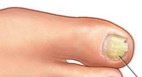
Treatment: Thickened nails are easily treated by filing and/ or drilling. Don’t worry, it’s pain-free!
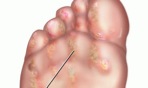
Treatment: Diagnosis and appropriate advice/ treatment given, often by using anti-fungal or antibacterial creams. Follow-up care if necessary and referral to GP if the problems persist.
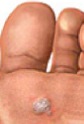
Treatment: I can treat these with a medicinal cream and in most cases I expose the verruca using a scalpel to remove the skin around the infection to expose the blood vessels of the verruca. This allows the cream to take effect. However, verrucae often need more than one treatment to be completely removed.

Normal nerves allow people to sense if their shoes are too tight or if their shoes are rubbing on the feet too much. With diabetes, you may not be able to properly sense minor injuries such as cuts, scrapes and blisters-all signs of abnormal wear, tear, and foot strain.
Treatment: A diabetic foot care assessment applicable for the diabetic patient. Depending on that assessment a decision is then taken on diagnosis and treatment and/ or prevention. This includes:
- Testing for peripheral neuropathy using a tuning fork/microfilament.
- Referral for a Doppler test if necessary.
- Referral to diabetic clinic/ GP if necessary.
- Advice re frequent and correct professional nail cutting.